
Germany Hits New Solar All-Time High in July – 12 Billion kWh of Solar Power Fed into the Grid for the First Time
Münster – Germany's photovoltaic sector reached a new record in July 2026. For the first time, around 12 billion kWh of solar power were fed into the public electricity grid within a single month. The figures come from an analysis of quarter-hourly feed-in data from the European grid operator platform ENTSO-E conducted by the Internationales Wirtschaftsforum Regenerative Energien (IWR).
Monthly Average Solar Output Exceeds 40,000 MW at Midday
The new monthly record underscores the growing importance of photovoltaics for Germany's electricity supply. Total solar generation was significantly higher than the 12 billion kWh figure, as the analysis only captures grid feed-in and does not include solar power consumed directly on-site.
According to IWR's analysis, average midday solar output in July exceeded 40,000 MW. This capacity was available precisely during the time of day when electricity demand in Germany is particularly high. In calculated terms, this corresponds to the electrical output of more than 40 nuclear power plants with a capacity of 1,000 MW each. Over the course of the day, photovoltaics displaced a significant share of electricity generation from coal- and gas-fired power plants.
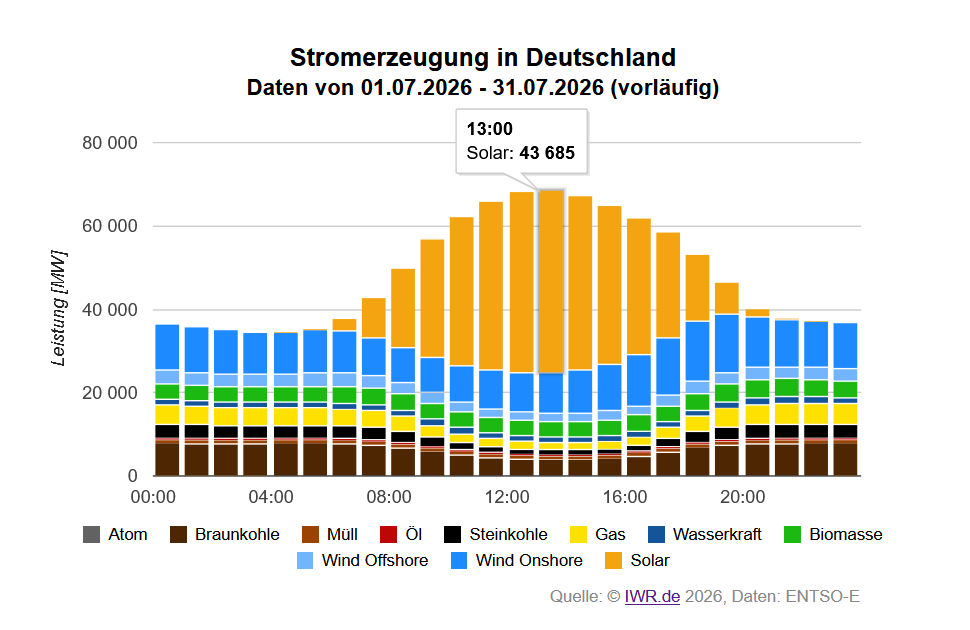
Photovoltaics has evolved from a supplementary generation technology into a key pillar of Germany's electricity supply. Millions of private homeowners, farmers, businesses and mid-sized companies have made a significant contribution to this development over the past two decades through investments in solar installations.
EEG: IWR Points to Misconceptions Around Solar Support
New residential photovoltaic systems currently receive a statutory remuneration entitlement of around 7 cents per kilowatt-hour fed into the grid. This often creates the impression that these 7 cents represent the state solar subsidy. However, this is incorrect.
"Photovoltaics is now a key pillar of Germany's electricity supply. This makes an objective discussion of the actual EEG differential costs all the more important. However, the frequently used term solar subsidy is misleading. It suggests that every kilowatt-hour fed into the grid is fully paid for from public funds. In reality, for new photovoltaic systems, the EEG only compensates for the difference between exchange revenues and the statutory remuneration entitlement. This misconception continues to shape the public debate to this day," said Dr. Norbert Allnoch.
Solar Support: EEG Only Offsets the Differential Costs
Electricity generated by photovoltaic systems is first marketed on the electricity exchange. The resulting exchange revenues flow into the EEG account. Only the difference between exchange revenues and the statutory remuneration entitlement is subsequently offset.
If solar power achieves an exchange price of, for example, 5 cents per kilowatt-hour, the compensation paid from the EEG account amounts to 2 cents per kilowatt-hour. If the exchange price is 8 cents per kilowatt-hour, however, the plant operator still receives their statutory remuneration entitlement of 7 cents per kilowatt-hour, while 1 cent per kilowatt-hour remains in the EEG account. The EEG differential costs are therefore not determined by the statutory remuneration entitlement itself, but solely by the difference between exchange revenues and the remuneration entitlement.
Legacy PV Systems Continue to Account for Most EEG Differential Costs
According to IWR, today's EEG differential costs are largely driven by legacy photovoltaic systems, particularly those installed between 2010 and 2013. Due to significantly higher investment costs at the time, these systems still have statutory guaranteed remuneration rates, in many cases ranging from 30 to more than 40 cents per kilowatt-hour.
These remuneration entitlements each apply for 20 years and will expire gradually between 2030 and 2033. Only once these legacy contracts expire will historical EEG differential costs decline significantly, independently of the remuneration paid for new photovoltaic systems.
Source: IWR Online, 04 Aug 2026
