
Wind Power Meets Architecture: Europe’s First Parking Garage Built With Recycled Rotor Blades From A Vattenfall Wind Farm In Sweden Opens
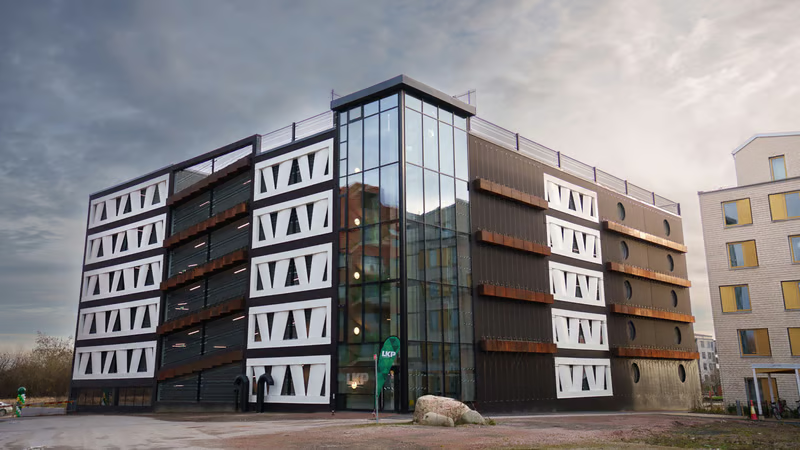
Stockholm (Sweden) – In Lund, in the southern Swedish province of Skåne, Europe’s first parking garage incorporating decommissioned wind turbine rotor blades has been opened. The parking facility is owned by the municipal company Lunds kommunala parkeringsbolag (LKP).
“It's a very smart idea and a really nice building,” said Anne Mette Traberg, Country Manager of Vattenfall Denmark.
Architect Jonas Lloyd came up with the idea for the parking garage after reading a magazine article about the American wind industry and its challenges in recycling end-of-life rotor blades. Rotor blades are designed to withstand decades of wind and weather and are therefore made of various composite materials such as glass and carbon fibers. This makes them extremely durable, but also difficult to recycle. “I read that in the US, many of the blades are buried, and I thought they could be put to better use. It's not just an environmental problem, but also a waste,” Lloyd said.
When LKP commissioned a new parking garage, Jonas and his colleagues therefore designed a building made from rotor blades. From the outset, the idea behind the building was to set an example for sustainable architecture in every respect. In addition to the rotor blades, the façade also features bee-friendly plants, and the roof is covered with solar panels connected to a battery system to charge cars at night.
With more than 1,400 wind turbines in several countries, Vattenfall is one of Europe’s largest wind developers. Recycling rotor blades and other components of wind turbines is therefore a natural and important part of the company’s wind activities. According to Anne Mette Traberg, it is important to demonstrate the significance of the circular economy for Vattenfall and to prove that rotor blades can indeed be recycled. That is why it made sense to provide the decommissioned blades. “This is visible and concrete proof that sustainability can meet the cost, schedule and safety requirements of a project,” Traberg said.
LKP CEO Paul Myllenberg described the project as a success: “ Reality exceeded expectations. Fortunately, we have a courageous board.” LKP is already exploring further uses for the donated rotor blades, including as part of a competition for creative reuse.
Source: IWR Online, 18 Dec 2025
