
Fraunhofer ISE Uses Industrial Exhaust Gases for Methanol Production – Digital Twin Increases Efficiency by 39 Percent
Freiburg (Germany) – Large quantities of metallurgical gases are generated during steel production, which have so far remained unused and contribute to CO? emissions. Fraunhofer ISE now demonstrates how these exhaust gases can be utilized as raw materials and converted into methanol – supported by a digital twin to optimize the processes.
Metallurgical gases from the steel industry as a raw material for the chemical industry
Large quantities of coke oven gas, blast furnace gas, and converter gas are produced during steel manufacturing. These metallurgical gases contain hydrogen and carbon oxides but are often released unused into the atmosphere. Steel plants are responsible for around six percent of Germany’s CO₂ emissions, which makes the material use of these gases highly significant.
To reduce these emissions, the Carbon2Chem® project is investigating the conversion of metallurgical gases into basic chemical feedstocks. Methanol plays a central role here: it can be used as a base chemical and as a hydrogen carrier for the energy transition.
Digital twin significantly increases methanol production
A key tool for optimization was a digital twin of the methanol synthesis plant. It maps reactor geometry, catalysts, and dynamic operating conditions, enabling precise simulations.
“The basis of the digital twin is knowledge of a kinetic model that describes the underlying reactions with very high accuracy,” explains Dr. Florian Nestler from Fraunhofer ISE. Dr. Achim Schaadt from Fraunhofer ISE adds: “On this basis, reliable techno-economic optimizations can be carried out in the next step.”
The simulation, based on more than 5,000 operating hours, identified optimal parameters for reactor inlet temperatures, recycle ratio, and hydrogen addition. By implementing these recommendations, methanol production was increased by 39 percent. Project manager Max Hadrich emphasizes: “Model-based optimization was significantly more efficient than a purely experimental search for better operating points.”
In addition, the digital twin offers prospects for further power-to-X applications. Dr. Matthias Krüger from Thyssenkrupp Uhde highlights: “Digital twins are particularly important tools for understanding and optimizing catalysts and process technology, especially for Power-to-X processes with fluctuating input conditionss.” The platform is also expected to be used in the future to simulate and optimize the production of dimethyl ether and jet fuels.
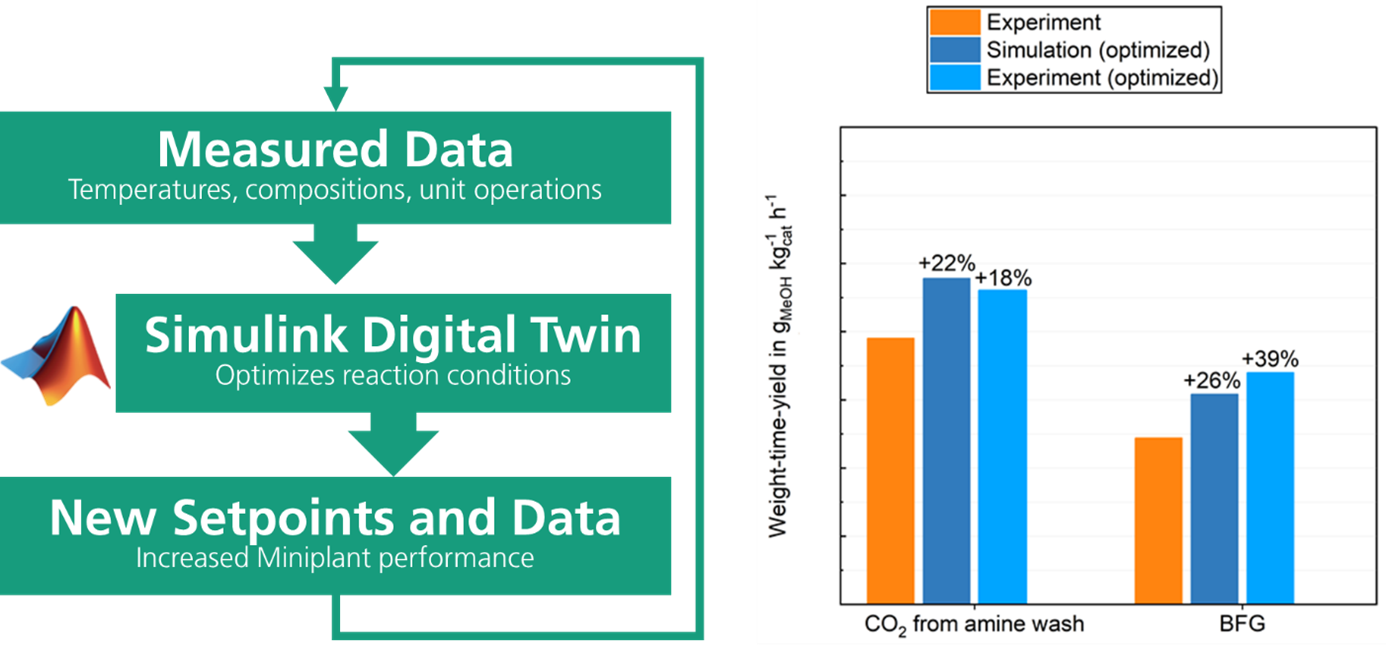
With Carbon2Chem®, Fraunhofer ISE provides an important impetus for the climate-friendly transformation of the chemical industry and demonstrates how digital twins can increase the efficiency of industrial synthesis processes.
Source: IWR Online, 30 Mar 2026
