
Nuclear Power Plants in Germany: What Happens to Former Nuclear Sites After the Nuclear Phase-Out
Münster – Commercial nuclear power generation in Germany has come to an end. Even though public debate continues over a possible renaissance or reactivation of nuclear power plants, the future use of former nuclear power plant sites has already largely been determined – and in some cases is already being implemented.
Grohnde Nuclear Power Plant Site (Lower Saxony) – Grid and Storage Hub in Northern Germany
At the Grohnde site, a pressurized water reactor with a gross capacity of around 1,430 megawatts operated until its final shutdown. After around 36 years of operation, the plant was taken offline on December 31, 2021. The first decommissioning and dismantling permit for the Grohnde nuclear power plant had already been granted in December 2023. The second permit now issued is based on an application submitted by operator PreussenElektra in 2024.
The interim storage facility for highly radioactive waste remains unaffected. Grohnde is already in the dismantling phase while simultaneously being developed into a future energy infrastructure hub.
Plans for future use focus on a large battery storage facility, a solar park with around 72 MW, and a new substation to integrate additional north–south electricity flows. Due to its existing grid connection, Grohnde is considered a potential central grid and storage hub in the northern German power system.
Gundremmingen Nuclear Power Plant Site (Bavaria) – Large-Scale Storage and Infrastructure Site in Southern Germany
For decades, Gundremmingen was Germany’s largest nuclear power plant site by generation capacity. The last two units, B and C, each had a gross capacity of around 1,344 megawatts. Unit B was shut down in 2017 after around 33 years of operation, while Unit C followed at the end of 2021 after around 36 years.
The former Unit A had already been permanently shut down in 1977 after around 10 years of operation following a serious incident.
Today, the site is undergoing dismantling while also being discussed as a potential location for large-scale energy storage and grid stabilization. Given its location in southern Germany, integration into future hydrogen and electricity infrastructure is a particular focus.
Gundremmingen is therefore expected to develop into a major storage and infrastructure site for the southern German energy transition.
Isar Nuclear Power Plant Site (Bavaria) – Integrated Energy Hub for Electricity, Storage and Flexible Generation
The Isar site is among the last nuclear power plants shut down in Germany. Unit 2 had a gross capacity of 1,485 megawatts and was shut down in April 2023 after around 35 years of operation. Unit 1 had already been permanently shut down in 2011 after around 32 years.
Concrete transformation plans already exist for the Isar site: RWE is developing an integrated energy project there consisting of battery storage, photovoltaics, and a flexible gas-fired power plant site. The aim is to continue using the existing grid infrastructure while simultaneously providing flexible generation capacity for the energy transition.
Isar is therefore regarded as an example of transforming a former baseload site into a flexible energy hub with storage, solar, and backup capacities.
Philippsburg Nuclear Power Plant Site (Baden-Württemberg) – Grid and Storage Site in Southwestern Germany
At Philippsburg, Unit 2 with a gross capacity of 1,468 megawatts was shut down at the end of 2019 after around 35 years of operation. Unit 1, with 926 megawatts, had already been taken offline in 2011 after around 32 years.
Philippsburg is thus evolving into a classic grid and storage location for the energy transition in southwestern Germany. The site serves as the southern converter and feed-in node of the Ultranet HVDC connection (2 GW) toward Osterath in North Rhine-Westphalia. EnBW continues to use the state’s most powerful grid node, including plans for large-scale battery storage systems.
Lingen Nuclear Power Plant Site (Lower Saxony) – Focus on Hydrogen
The Lingen site also belongs to the last generation of German nuclear power plants. Unit 2 (Emsland), with around 1,406 megawatts, was shut down in April 2023 after around 35 years of operation, while Unit 1 had already been shut down in 1977 after around 10 years.
Alongside dismantling activities, Lingen is increasingly developing into a site for hydrogen projects and industrial energy conversion. In particular, the proximity to existing gas infrastructure plays a central role.
The site is therefore regarded as a potential hub for the emerging hydrogen economy in northwestern Germany.
About Germany’s Nuclear Phase-Out
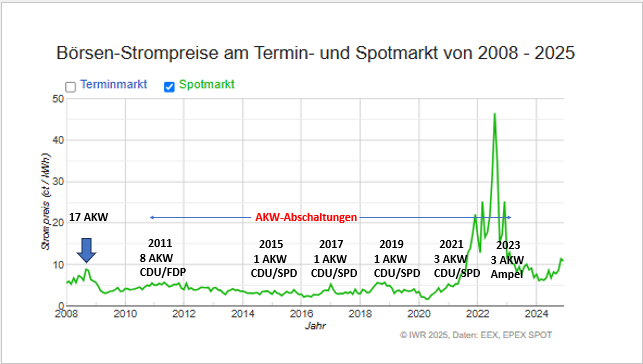
Germany’s nuclear phase-out began with the nuclear consensus adopted by the SPD-Green federal government in 2000/2001 and the corresponding legislation in 2002, initially without fixed shutdown dates for individual nuclear power plants. Instead, the phase-out was regulated through limits on nuclear electricity generation volumes, which would have resulted in a complete phase-out by 2021 at the latest.
On October 28, 2010, the CDU/CSU and FDP federal government decided to extend the operating lifetimes of nuclear power plants by eight or 14 years. Under this plan, the last nuclear power plants would have remained online until around 2035.
In 2011, following the Fukushima nuclear disaster in March of that year, the federal government (CDU/CSU, FDP) decided to phase out nuclear power by 2022 and defined fixed shutdown dates for each individual nuclear power plant in the Nuclear Phase-Out Act (BGBl. I 2011, p. 1704).
In response to the energy crisis following Russia’s invasion of Ukraine, the coalition government of SPD, Greens, and FDP extended the operating lives of the last three remaining nuclear power plants by three months in autumn 2022. The Isar 2, Emsland, and Neckarwestheim 2 nuclear power plants continued operating under a temporary lifetime extension until April 15, 2023.
Source: IWR Online, 21 May 2026
