
Power Market: Oil and Gas Price Shock Fuels Inflation Pressure – Renewables and Storage Offer Best Protection
Münster – A renewed price shock in oil and gas markets is intensifying inflationary pressure in Europe and again drawing attention to the region's dependence on fossil fuel imports. In IWR's view, domestic renewable energy combined with battery storage offers the best protection against such price shocks.
ECB Raises Key Interest Rates on September 10: IWR Points to Fossil Fuel Price Drivers
On September 10, 2026, the European Central Bank (ECB) raised its key interest rates by 0.25 percentage points. In doing so, it explicitly cited the ongoing inflationary pressure stemming from the conflict in the Middle East. Because oil and gas prices are set on international markets, this price risk cannot be mitigated by switching to other supplier countries or delivery routes. "The drivers of these price increases have a name: fossil fuels. The best protection against inflation is the transformation from oil and gas to electricity generated from domestic renewable energy, combined with energy storage," said Dr. Norbert Allnoch, CEO of Internationales Wirtschaftsforum Regenerative Energien (IWR).
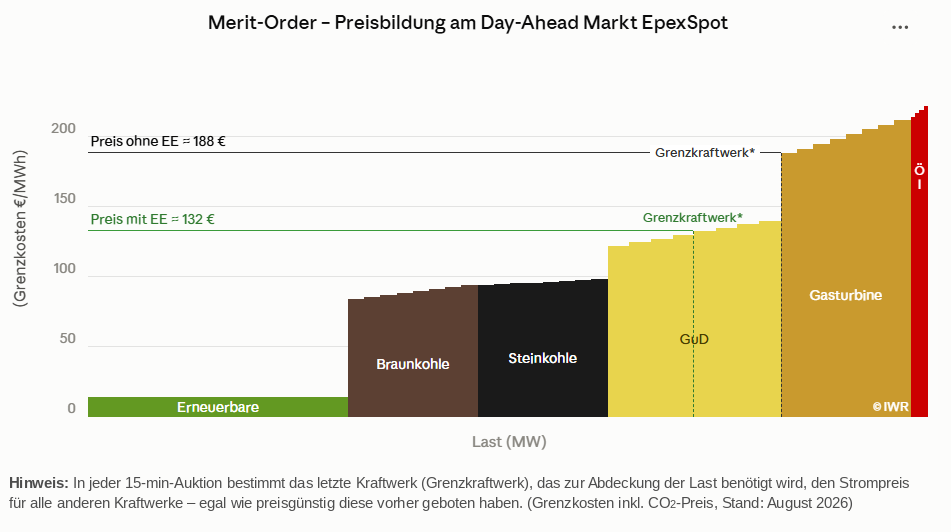
TTF Gas Price of EUR 80 per MWh Pushes Gas-Fired Plants Out of the Merit Order
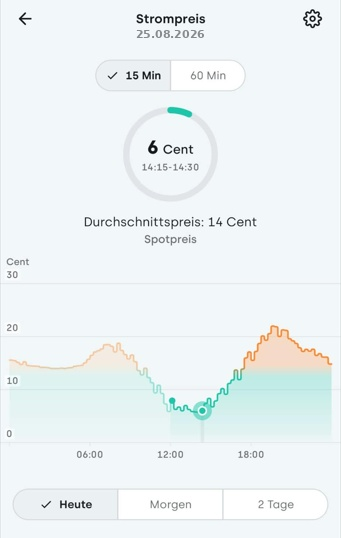
How low-cost solar power affects electricity price formation becomes evident on sunny days: as PV generation rises, exchange electricity prices often fall sharply toward midday, then climb again in the evening as solar output declines. In public debate, this pattern is often explained through a misleading chain of causation: too much solar power allegedly creates an "oversupply," overloads the grids, and has to be "dumped" abroad at low prices. This conflates price formation on the exchange with grid operations.
Bundesnetzagentur: More Than 96 Percent of Renewable Electricity Fed into the Grid in 2025
Independent of price formation, regional grid bottlenecks occur and at times lead to curtailment of renewable installations. A low or negative exchange price is therefore not automatically an indication of grid congestion: according to the Bundesnetzagentur, more than 96 percent of the renewable electricity generated in 2025 was fed into the grid and reached end consumers. By 2028, four new north-south power lines – Ultranet (2,000 MW), A-Nord (2,000 MW), SuedLink (4,000 MW), and SuedOstLink (2,000 MW) – are also to be connected to the grid, increasing transmission capacity between generation centers in the north and consumption centers.
Battery Storage Shifts Cheap Power into Expensive Hours
These low-cost midday hours are precisely what create the economic incentive for battery storage: batteries charge with electricity at low prices and discharge it again during the more expensive morning and evening hours. This raises demand at midday during charging and increases supply during the expensive hours when discharging – exchange electricity prices fall accordingly, and gas-fired plants less often set the price. The more low-cost renewable electricity can be shifted in this way, the less international gas prices feed through to German exchange electricity prices.
IWR Criticizes Federal Government: State-Subsidized Gas-Fired Plants Pose Electricity Price Risk
Against this backdrop, IWR takes a critical view of the federal government's course: state-subsidized gas-fired plants that are permitted to operate on the electricity market in addition to their reserve function carry their own price risk when gas prices are high, since their fuel costs feed directly into the exchange price via the merit order whenever they are needed. "A permanently competitive level of electricity prices is of central importance for the German economy. That goal conflicts with a federal government electricity market design in which expensive fossil plants frequently set the exchange electricity price. What matters is that the fossil price risk of these plants comes into effect as rarely as possible," said Allnoch.
To strengthen Germany as a business location, the focus should therefore be on expanding wind and solar energy together with privately financed battery storage. Renewable energy reduces dependence on internationally priced fossil fuels, while storage shifts low-cost power specifically into expensive hours. In this way, renewable energy and storage help ensure that expensive fossil-fuel plants determine the exchange electricity price less often.
Source: IWR Online, 15 Sep 2026
