
NeuConnect Reaches next Milestone – First Direct Power Link Between Germany and the UK Takes Shape
Wilhelmshaven (Germany) / London (UK) – The expansion of cross-border electricity interconnections in Europe is becoming increasingly important as European power markets continue to integrate and renewable energy deployment accelerates. The NeuConnect interconnector between Germany and the UK is currently creating the first direct electricity connection between the two countries – and one of Europe’s largest energy infrastructure projects.
Large transformers: Key technology for the “invisible energy highway”
The total of 14 large transformers were manufactured by energy technology company Siemens Energy and are central components of the high-voltage direct current (HVDC) transmission system. Installed at both ends of the interconnector within the converter stations, they convert alternating current into direct current and vice versa. At the same time, they adjust voltage levels between the power grid and the transmission line, enabling bidirectional electricity transport between Germany and the UK.
Each transformer measures around seven metres in length, five metres in height and weighs more than 200 tonnes. The units were transported by inland waterway vessel from Nuremberg via the Rhine to Rotterdam, and from there onward to Wilhelmshaven and the Isle of Grain at the Thames Estuary in the UK.
NeuConnect CEO Arnaud Grévoz described the transformer deliveries as an important logistical and technical milestone in the construction of the interconnector. He noted that the converter stations are now visibly taking shape, while offshore and onshore cable installation is progressing according to schedule.
Progress onshore and offshore – construction work on schedule
At the same time as the transformer deliveries, construction work at both converter station sites is progressing at full speed. The buildings in Fedderwarden near Wilhelmshaven and on the Isle of Grain have now reached their final height of around 24 metres. Facade works are already underway.
Cable installation is also advancing steadily. Prysmian Group’s cable-laying vessel “Leonardo da Vinci” has completed work in UK waters and is currently continuing installation of the approximately 725 kilometres of subsea cable in Dutch waters. On the German side, installation work between the North Sea coast and the converter station is nearing completion.
According to the project company, more than 300 kilometres of subsea cable have already been installed.
NeuConnect to strengthen integration of electricity markets
From 2028 onwards, NeuConnect will directly connect the electricity markets of Germany and the UK for the first time. With a transmission capacity of 1.4 GW, the link will be able to transport electricity flexibly in both directions and theoretically supply up to 1.5 million households.
The project is considered an important building block for European energy integration and the integration of renewable energy sources. By improving electricity trading between the two countries, NeuConnect is expected to strengthen both energy security and grid stability.
The project is financed by an international consortium of investors including Meridiam, Allianz Capital Partners, Kansai Electric Power and TEPCO Power Grid.
Germany: New power links with 11.4 GW capacity to enter operation by 2028
According to current plans, new HVDC transmission links with a combined capacity of 11.4 GW (11,400 MW) are scheduled to enter operation in Germany over the next two years. These include A-Nord (2 GW), Ultranet (2 GW), SuedLink (4 GW), SuedOstLink (2 GW) and NeuConnect (1.4 GW).
The north-south transmission corridors with a total capacity of 10 GW are expected to be completed around six years later than originally planned. Germany’s original 2012 Grid Development Plan (NEP 2012), adopted following the country’s 2011 nuclear phase-out decision, had targeted completion of the major transmission lines by 2022, in parallel with the shutdown of the final nuclear power plants.
The revised planning was triggered primarily by the underground cable priority policy for major north-south electricity corridors promoted in 2015 by then Bavarian Minister-President Horst Seehofer (CSU). The political decision to prioritise underground cables over overhead lines resulted in multi-billion-euro additional costs – including redispatch expenses – and significant delays to grid expansion.
The new HVDC transmission lines are expected to generate billions in cost savings for Germany in the coming years. Until now, wind turbines in northern Germany in particular have frequently had to be curtailed despite their electricity already having been sold via power exchange auctions. The main reason has been insufficient transmission capacity towards southern Germany. With the new HVDC power corridors entering operation from 2028 onwards, this situation is expected to improve significantly.
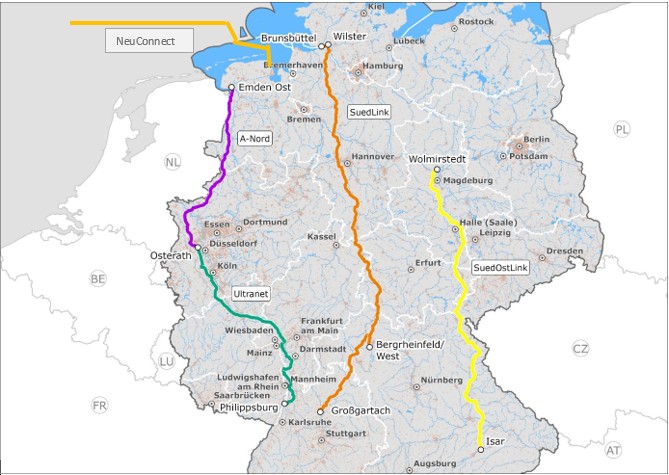
Source: IWR Online, 12 May 2026
