
Heat and Low Water Strain Europe's Nuclear Plants — Romania Without Nuclear Power for First Time Since 2003
Münster – An extremely hot and dry summer is straining nuclear power plants in several European countries at once. France, Switzerland, Hungary and Romania have all been forced to curtail or shut down reactors in recent weeks due to water shortages, high water temperatures and a jellyfish infestation.
France: Heat, Low Water and Jellyfish Curb Nuclear Output
On August 12, 20.4 percent of France's nuclear capacity was unavailable due to environmental constraints, according to an analysis of EDF data by news agency AFP. AFP said this marked a record since comparable data collection began in 2015. Thirteen of France's 57 reactors were affected: eight were fully shut down and five were operating at reduced capacity. Combining unavailable and curtailed capacity, AFP reported that up to 7.3 gigawatts of capacity was temporarily unavailable for power generation on that day.
EDF has documented weather-related constraints at several of its sites. At the Chooz nuclear plant, EDF shut down both 1,450 MW units due to low water levels in the Meuse River and the need to comply with the 1998 Franco-Belgian agreement on minimum water flow. At Golfech, Unit 2 (1,310 MW) was shut down because of high water temperatures in the Garonne River. At Gravelines, France's largest nuclear plant with six 900 MW reactors, a massive jellyfish influx disrupted the cooling water supply. According to EDF, the jellyfish triggered the automatic shutdown of Units 3 and 4 on August 10, while Unit 2 was shut down as a precaution and Unit 1 was reduced to 50 percent capacity. Unit 2 was reconnected to the grid on August 13, while Units 3 and 4 initially remained offline.
Switzerland: Both Beznau Units Offline
Water temperature is also constraining nuclear operations in Switzerland. The Beznau nuclear plant in the canton of Aargau, comprising two 365 MW units, draws its cooling water directly from the Aare River. If the temperature of the Aare, after full mixing with returned cooling water, exceeds 25 degrees Celsius, Swiss utility and plant operator Axpo is required to reduce heat input and cut output by up to 50 percent. After several temperature-related power reductions and shutdowns over the course of the summer, both reactors, with a combined capacity of 730 MW, were fully shut down on July 31. Unit 2 has also been undergoing a scheduled fuel change since August 4.
Danube: Low Water Pressures Paks and Halts Cernavodă
The Danube River, where discharge levels across large stretches have fallen to their lowest in more than 30 years according to European climate service Copernicus, illustrates how heavily nuclear plant availability depends on water flow.
At Hungary's Paks plant, which has a total capacity of 2,000 MW according to operator MVM Paksi Atomerőmű, Units 1, 3 and 4 had to be shut down due to low water levels. Unit 2 (500 MW) subsequently ran at 50 percent capacity for eleven days. After water levels improved, operator MVM began gradually restarting Unit 2 on August 10.
Further downstream, the situation worsened in Romania. The Cernavodă nuclear plant, with total capacity of around 1,400 MW, is operated by state-owned company Nuclearelectrica S.A. The company began a controlled shutdown of Unit 2 (700 MW) on August 13, citing the continuing drop in Danube water levels. Unit 1 (700 MW) had already been shut down in late July for the same reason. Both reactors at Romania's only nuclear power plant are therefore currently offline. According to AFP, this marks the first complete shutdown of the plant since the drought of 2003.
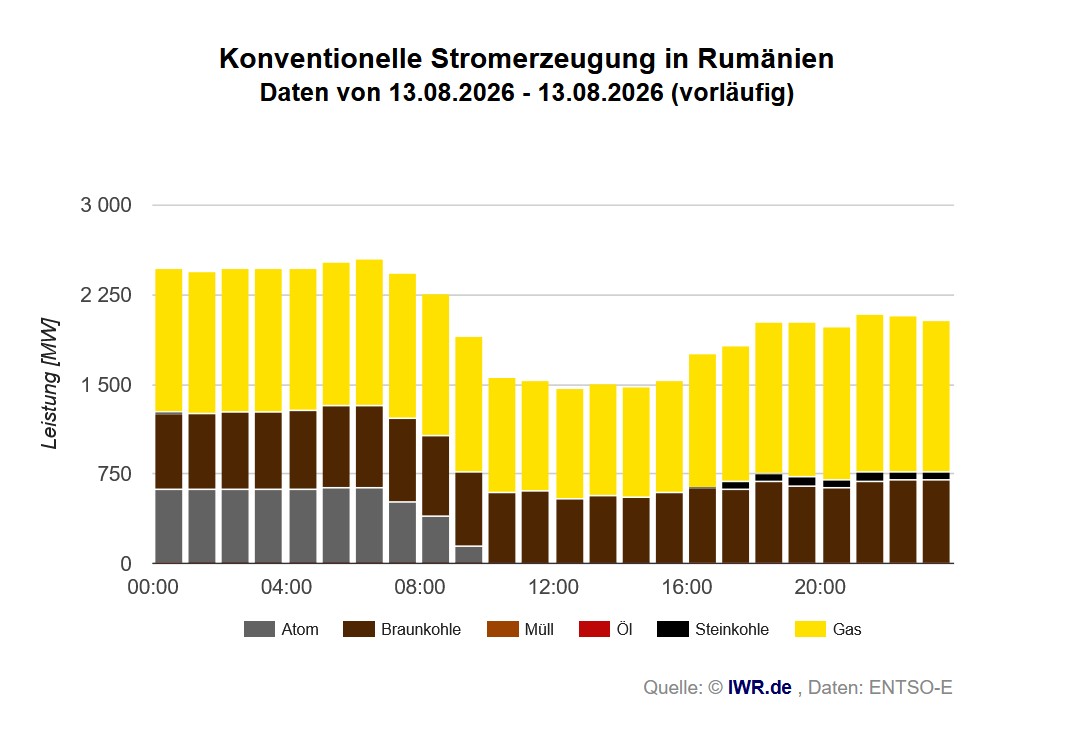
Source: IWR Online, 18 Aug 2026
